CCA-F Exam Overview ; Format, Domains, and What Actually Gets Tested
The Claude Certified Architect Foundations exam: format, scoring, five domains, eight scenarios, and how to register. Everything you need before you open a study guide.
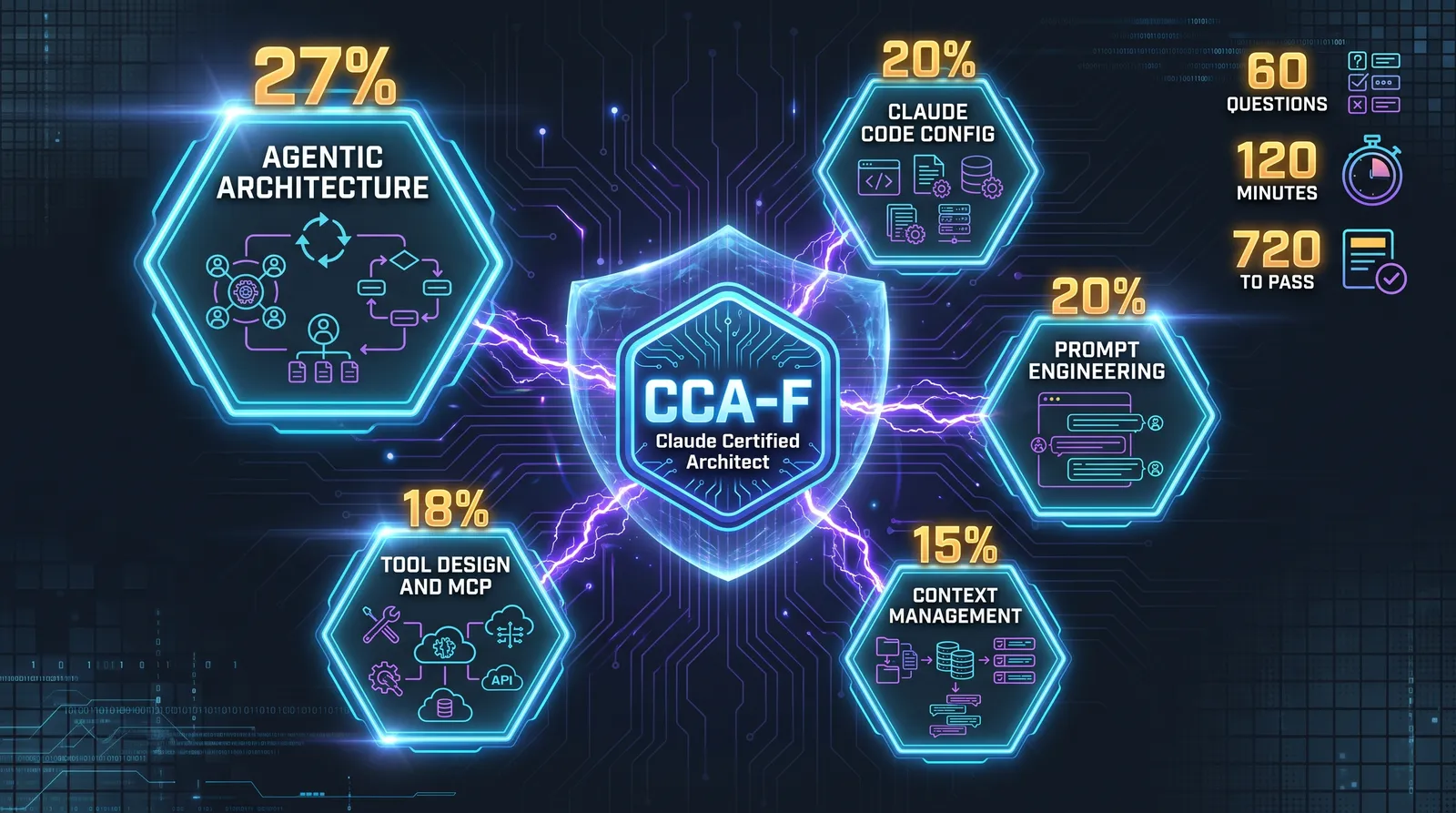
The Claude Certified Architect: Foundations certification launched March 12, 2026 as Anthropic's first official technical credential. It is a proctored, scenario-based exam that validates production-grade knowledge of Claude agents, Claude Code, the Claude API, and the Model Context Protocol. This is not a multiple-choice trivia test. Every question places you inside a realistic engineering scenario and asks you to make the correct architectural call.
If you have built real agents, configured Claude Code in production, and designed MCP tools, the content will be familiar. What the exam tests is whether your knowledge is precise enough to distinguish the architecturally correct answer from the three answers that are merely technically plausible.
Exam Format at a Glance
| Parameter | Value |
|---|---|
| Question type | Multiple choice, one correct answer out of four |
| Question count | 60 questions |
| Duration | 120 minutes |
| Passing score | 720 out of 1000 (scaled) |
| Guessing penalty | None. Answer every question. |
| Scenarios | 4 randomly selected from 8 possible |
| Format | Proctored, closed-book |
| Cost | Free for the first 5,000 partner employees, then $99 USD |
The scoring is domain-weighted. A single domain where you score below 50 percent can determine pass or fail regardless of how well you do on the others. Proportional study time is not optional: spending equal hours on a 15 percent domain and the 27 percent domain wastes limited preparation hours.
The Five Domains
The exam is divided into five domains. Knowing the weight of each one before you study is the most important scheduling decision you will make.
| Domain | Weight | What it tests |
|---|---|---|
| Agentic Architecture and Orchestration | 27% | Agent loops, multi-agent coordination, hooks, escalation |
| Claude Code Configuration and Workflows | 20% | CLAUDE.md hierarchy, MCP config, CI/CD, skills |
| Prompt Engineering and Structured Output | 20% | Few-shot examples, JSON schemas, batch API tradeoffs |
| Tool Design and MCP Integration | 18% | Tool descriptions, error responses, transport selection |
| Context Management and Reliability | 15% | Lost-in-the-middle, progressive summarization, state |
Domain 1 at 27 percent is the heaviest. Candidates who fail often have one domain below 50 percent, and it is usually either Domain 1 or Domain 4. Both are highly practical and penalize anyone who has only read documentation without building real systems.
The Eight Scenarios
During the exam, four scenarios are randomly selected from eight possible. All questions in your exam are anchored to those four scenarios. You do not know which four you will get, so you need to prepare for all eight.
Scenario 1: Customer Support Resolution Agent
You are building an agent to handle returns, billing disputes, and account issues using the Claude Agent SDK. The agent has access to MCP tools: get_customer, lookup_order, process_refund, and escalate_to_human. The target is 80 percent first-contact resolution with appropriate escalation. Questions focus on agent loop design, escalation triggers, hook enforcement for financial operations, and tool description quality.
Scenario 2: Claude Code Configuration
A team needs to implement Claude Code with shared configuration, custom slash commands, and CLAUDE.md setup for a multi-person engineering workflow. Questions test the CLAUDE.md hierarchy (which level goes where), path-scoped rules in .claude/rules/, and when to use planning mode versus direct execution.
Scenario 3: Multi-Agent Research System
A coordinator agent delegates tasks to specialized subagents for web research, document analysis, synthesis, and report generation. The system must produce complete reports with citations and handle partial failures gracefully. Questions target explicit context passing, parallel subagent execution, structured error responses, and coverage annotations.
Scenario 4: Developer Productivity Tools
An engineering assistant navigates unfamiliar codebases and generates boilerplate using built-in Claude Code tools (Read, Write, Bash, Grep, Glob) and custom MCP servers. Questions address when to prefer MCP tools over built-in tools and how tool descriptions affect selection.
Scenario 5: Claude Code in CI/CD
Integrate Claude Code into a CI/CD pipeline for automated code review and test generation. Questions test the -p flag for non-interactive mode, --output-format json, session isolation between code generation and review, and minimizing false positives.
Scenario 6: Structured Data Extraction
Extract structured information from unstructured documents, validate with JSON schemas, and handle edge cases (missing data, ambiguous fields, informal measurements). Questions target schema design: required versus nullable fields, enum design with "other" and "unclear", and validation-retry loops.
Scenario 7: Conversational AI Architecture
Design multi-turn conversational systems covering context window management, instruction persistence across turns, memory strategies, and tool design for safe execution. Questions cover the lost-in-the-middle effect, fact extraction into structured blocks, and when to escalate versus retry.
Scenario 8: Agentic AI Tools
This scenario covers production agentic tool integration patterns. It is the least documented of the eight but typically focuses on tool_choice strategies, hooks for policy enforcement, and minimal-footprint agent design.
Who Should Take This Exam
The target candidate is a solution architect with at least six months of hands-on experience building production Claude applications. You should be comfortable with the Claude Agent SDK, Claude Code CLAUDE.md configuration, MCP server design, prompt engineering with JSON schemas, and long-context management patterns.
The exam is designed to be harder than it looks for passive learners and easier than expected for active builders. If you have built a real multi-agent system, configured CLAUDE.md for a team, and designed at least one MCP tool, the pass rate is high. If you have only read the documentation, the scenario-based format will surface gaps quickly.
Registration
- Apply to the Claude Partner Network at
anthropic.skilljar.com/page/claude-partner-network-learning-path - Use a business email address. Partner approval gates access to the CCA course and exam registration.
- Once approved, access the CCA course at
anthropic.skilljar.com/early-adopter-claude-certified-architect-foundations - While waiting for approval: complete the 18 free public Anthropic Academy courses at
anthropic.skilljar.com. These cover all five exam domains and are the primary study material even after partner access is granted.
The exam was free for the first 5,000 partner employees under the early adopter program. Check current pricing at registration time.
Study Resources
| Resource | What it covers |
|---|---|
| Anthropic Academy on Skilljar | 18 free courses, primary study material, covers all domains |
| Anthropic Docs at platform.claude.com | API reference, prompt engineering, tool use, MCP |
| MCP Specification at modelcontextprotocol.io | Full protocol spec |
| Claude Code Docs at code.claude.com | CLI reference, CLAUDE.md, hooks, skills |
| Community Study Guide on GitHub | paullarionov/claude-certified-architect, 1,900+ stars, multi-language |
| claudecertifications.com | 25 free practice questions with explanations |
| certsafari.com | 615+ exam-style questions |
What the Next Three Lessons Cover
The remaining lessons in this module go domain by domain with the level of precision the exam requires. They are organized by the most impactful domains first.
Lesson 2 covers Domains 1 and 3 (Agentic Architecture and Claude Code Configuration), which together represent 47 percent of the exam. These are the most technical and the most likely to trip candidates who have not built real systems.
Lesson 3 covers Domains 4 and 2 (Tool Design and MCP Integration, Prompt Engineering and Structured Output), representing 38 percent. Tool descriptions and JSON schema design are the most underestimated areas on the exam.
Lesson 4 covers Domain 5, all eight scenario patterns in detail, the most common wrong-answer traps, and the exam-day tactics that separate high scores from borderline passes.