ARTEX Has No New Exploits. It Has a Planner.
Microsoft published its full ARTEX breakdown this week, and the honest headline is that nothing in the toolbox is new. Every tool in its default kit is one I have run by hand. What is new sits above the tools: a planner agent that reads a knowledge graph and picks the next move the moment a worker reports back. I build that architecture for authorized work, which is why I do not think the interesting control here is a signature. It is the one Microsoft buries in its deception section, and it works by lying to the planner.

ARTEX has spent the last two weeks being named as the thing that breaks large companies in minutes. Microsoft's own report says the opposite about the interesting part: ARTEX "does not introduce new attack techniques; it uses common, pre-existing penetration testing tools and techniques." Every tool in its default kit is one I have run by hand. What is new sits above the tools. A planner agent reads a knowledge graph of everything the campaign has learned, issues the next short instruction, and does that again the moment a worker reports back. I build this architecture for authorized work. That is why I think the name is a distraction and most teams are preparing to hunt the wrong layer.
What Microsoft published
On November 25, Microsoft Threat Intelligence released What defenders need to know about ARTEX, a full breakdown of the framework's architecture, tooling and detection surface.
ARTEX is an AI-driven penetration testing platform, named in Chinese as an AI autonomous penetration testing system. A Go backend coordinates multiple language model agents, with an embedded Next.js interface and PostgreSQL for storage. GitHub user Autumn-27 published it as open source in July 2026. The original developer removed the code in October, forks continue in other languages, and in November the China-based company ThreatBook claimed ownership and started selling access to "ARTEX Pro."
Microsoft reports that both state-sponsored and criminal actors have integrated it, naming Storm-0940, Storm-3358, Onyx Sleet, Pearl Sleet, Crystal Typhoon and Salt Typhoon. Its own summary of the pace: "Depending on the threat actor's configuration and the target's defenses, ARTEX can advance from reconnaissance to persistent, privileged access to a target organization in a matter of minutes."
The loop, not the toolbox
Read the architecture as an engineer rather than as a list of capabilities.
The operator defines the target scope. A goals model breaks the engagement into objectives that can be verified. A planner agent continuously reviews a knowledge graph of discovered assets and findings, then issues short attack directions that ARTEX calls intents. Worker agents claim an intent and execute it with a real shell and real offensive tools. They write new assets, facts and confirmed vulnerabilities back into the graph. Every update wakes the planner, which decides what comes next. The loop runs until the goals are met or the run hits its time or step limit. A reporter agent then documents each confirmed finding with reproduction steps and a proof of concept.
The default toolbox is unremarkable: nmap, netcat, telnet, whois, dig, curl, wget, Playwright driving Chromium, node, python3, git, ripgrep and jq. Operators commonly bolt on sqlmap, hydra, medusa, ncrack, nuclei, nikto, gobuster, ffuf, Metasploit, John the Ripper and hashcat. Nothing on either list would surprise anyone who has run a web application assessment.
Two configuration details matter more than the tool list. ARTEX can be pointed at virtually any model, including frontier models, open-weight models, and models the operator has abliterated to strip refusal behavior. Microsoft's conclusion follows directly: ARTEX activity "is not necessarily constrained by any single provider's safety controls or visible in any single provider's telemetry." An optional pool function then fails over between models when one is rate-limited, out of quota or erroring, with a configurable priority order and cooldown, so a long campaign survives losing a provider.
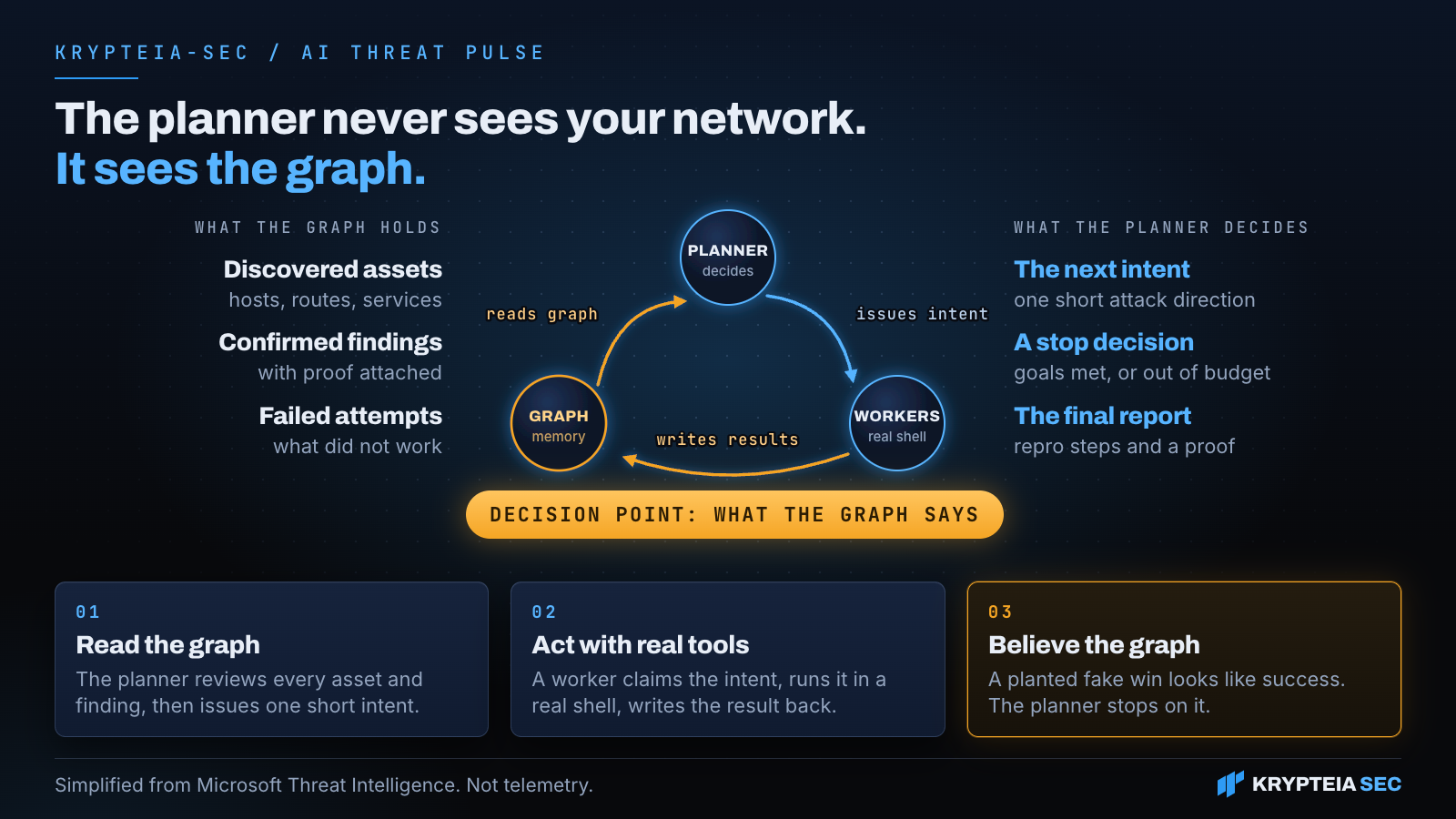
Figure 1. The ARTEX decision loop as described by Microsoft Threat Intelligence. The graph is the campaign's memory, and every write to it triggers the next planning decision. Simplified from the published write-up. Illustration, not captured telemetry.
What Microsoft says to hunt
Microsoft's ranking of evidence is the useful part, because it puts the weakest signal last.
The durable signal is behavioral. ARTEX agents, sometimes in parallel, iterate quickly and exhaustively through methods of access, exploitation and abuse, retrying variations until they succeed or run out of time, then dispatching further agents to the next stage at machine speed. A human moves between stages slowly. Microsoft also notes that other AI-driven offensive frameworks produce similar patterns, so this is a class of behavior rather than an ARTEX fingerprint.
Volume comes second. ARTEX makes no attempt to obfuscate, so automated tooling produces characteristically large bursts of anomalous traffic from one source.
Indicators come last, and Microsoft is careful about them. Two user agent strings are specific to ARTEX: artex-enrich/*, sent as a short GET to each newly discovered web asset that does not follow redirects and reads only enough of the response to extract the page title, and norma/*, used by the agents' built-in web-fetch tool. In the same breath Microsoft says operators "can and do vary network indicators like source IP address or user agent string, especially to bypass static or simple signature-based detection and blocking." Write the detection, but do not count it as coverage.
On the host, the evidence is familiar: web server processes spawning shells, new script files in web-accessible directories, rapid reads of /etc/shadow, .env files, private keys and cloud credential files. One detail reads like a transcript of an agent working: "Several short-lived web shells with incrementing names, each running a different command, as ARTEX agents correct errors until a web shell runs cleanly." That is a model debugging itself in production, and it is noisy.
Do not buy a control against a brand name
One correction before the useful part. ARTEX is popular, not special. It is one published framework among several, its source was pulled in October and the forks carry on, and a commercial vendor now sells a paid edition, which guarantees the name keeps appearing in briefings. None of that changes what the thing does.
Microsoft says the quiet part itself: "While ARTEX is a popular tool, other AI-driven offensive security frameworks also generate similar patterns of behavior." The detection you need is for the pattern, not the product. A control that only recognizes ARTEX fails on the next framework, and the next framework is a fork of this one in a different language.
So be careful with the question that follows a briefing about it. "Are we protected against ARTEX" has no useful answer. "Would we see one source move from scanning to credential access in four minutes, and do we hold the logs to prove it either way" has one.
The Operator's Take
I build agentic offensive tooling for authorized work, so the architecture in that report is not exotic to me. It is the design you arrive at when you want an engagement to keep making progress without a human in every decision. Which is also why I read the report looking for the part of the loop that can be attacked, not just observed.
That part is the knowledge graph. The planner does not perceive your network. It perceives the graph. Every decision it makes is a function of what workers wrote there. In an authorized build, that is the component I spend the most time on, because a wrong fact in the graph does not produce one wrong action. It produces a chain of confident actions in the wrong direction.
This is why the deception section of Microsoft's report is the one I would act on first, and not because deception is fashionable. Honeypots, decoys and tarpits work on any scanner. Microsoft names a fourth control that works specifically because of this architecture: "Fake wins present convincing evidence that the agent's objective is complete, which can cause it to stop on a false success." A goal-driven planner has to decide when it is done. Give it credible evidence that it is done, and it stops. No signature, no block, no patch. You attacked its belief about the engagement.
Microsoft reports that in its own testing these controls reduced attack traffic reaching real assets and produced high-confidence, attribution-quality signal. That is a vendor's test of its own guidance, and it is also the only proposed control I have seen that gets more effective as the attacker gets more autonomous.
Two limits I would not let slide. ARTEX agents verify findings, and a reporter agent writes reproduction steps, so a fake win has to survive a verification attempt rather than just look plausible on first read. And the model-pool means neither a provider's safety controls nor a provider's telemetry is a dependable boundary. Microsoft disrupts ARTEX-enabled attacks in its own product suite, and recommends enabling automatic attack disruption in Defender XDR, which is both reasonable advice and a product recommendation from the author of the report.
Five questions for Monday
- Would our detections survive a changed user agent? Write rules for
artex-enrich/*andnorma/*, then assume they were the first thing the operator changed and ask what fires next. - Do we alert on pace rather than payload? The reliable signal is one source moving through reconnaissance, exploitation and credential access within minutes. Check whether anything we own can even express that as a rule.
- Can we see our own logs? Microsoft's line belongs on a wall: "An empty result from a hunting query isn't proof that no access occurred if the underlying logs aren't collected." Confirm you collect identity sign-ins including service principals, API activity logs, web server logs and web application firewall logs before you trust a clean hunt.
- What happens after a web shell lands? Look for web server processes starting shells and for several short-lived scripts with incrementing names in upload directories. That failure-and-retry pattern is the agent, not a person.
- Do we have anything a goal-driven agent would accept as a win? Decoys that merely waste a human's time are not the same as a credible terminal state that ends a campaign. If you build one, assume it will be verified.
ARTEX did not invent an exploit. It removed the delay between learning something and acting on it, and it put the campaign's reasoning in a place defenders can influence. Hunt the pace, fix the logs, and consider lying to the planner.
Public-source analysis. Architecture, capabilities, indicators, hunting guidance and quotations are attributed to Microsoft Threat Intelligence. I did not test ARTEX, reproduce any campaign or validate Microsoft's detection or deception results.
- 00Your AI Coding Agent Is Already Allowed Out. That Is the Problem.
- 00ARTEX Has No New Exploits. It Has a Planner.
- 01The Autonomous Part Was The Part That Failed
- 02When Your AI Red Team Becomes Your SOC
- 03The Agent Never Broke the Sandbox. It Didn't Have To.
- 04Everything Is a Plugin Is a Security Statement
- 05Your Agent's Memory Is a Supply Chain
- 07Using Astra? Here's What It Can Do, and the Story Behind It.