Your AI Coding Agent Is Already Allowed Out. That Is the Problem.
The address your coding agent is allowed to reach is the same address an attacker could use to control it.
When a company lets a coding agent talk to its AI provider's API, it approves a destination. This week, Darktrace showed in a lab what that approval is worth to an attacker who already has a foothold. After setup, its researchers sent every remote job, read every result and moved a stolen file through api.anthropic.com, the address the coding agent was already approved to use.
What Darktrace did
On November 12, Darktrace Signal Labs published Living off the AI: Shared Memories as a Covert C2 Channel. C2 means command and control: the channel an attacker uses to send instructions to a compromised machine and get results back. Defenders hunt for that channel because malware usually has to call somewhere unusual to get its orders.
The researchers asked whether an attacker could skip that step and steer a coding agent through the agent's own approved channel. In their lab, it worked.
The setup had two ordinary parts. A small shell script landed on a Linux machine that ran Claude Code, Anthropic's coding agent. The script found the agent, collected the user's Claude credentials and sent them to the attacker's staging server. It then created a system service that kept launching new Claude Code processes.
The Claude platform has a feature called memory stores: collections of text files that let agents remember things between sessions. Darktrace used the stolen API key to add a memory store to the victim's workspace, with three files in it. According to Darktrace, a store can be added whether or not the organization uses Anthropic's Managed Agents service. Each new Claude Code process wrote a check-in to the first file, read a job from the second, did the job and wrote the result to the third. The operator read the result and wrote the next job.
All of that traffic went to api.anthropic.com, the same address the agent contacts for normal work. Once the loop was running, the original script and its staging server were no longer needed.
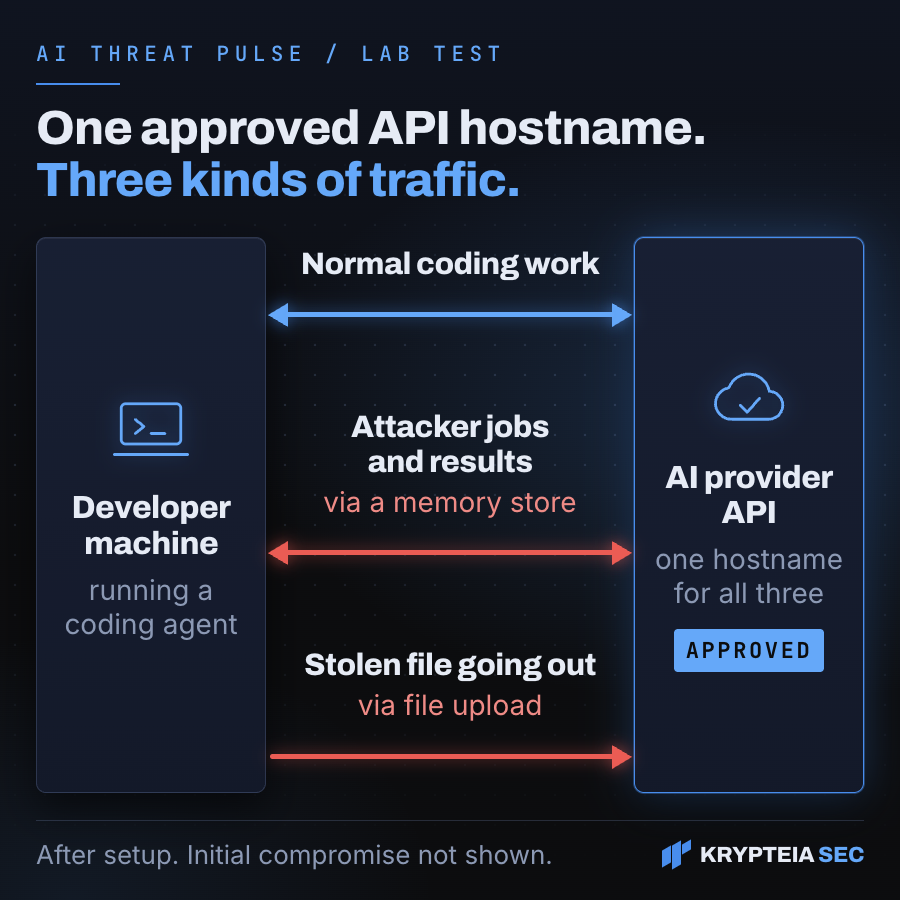
Figure 1. After setup, one approved API hostname carried normal work, inbound jobs, outbound results and file uploads. In Darktrace's lab test, the jobs and results moved through a memory store and the stolen file through the file upload service. The initial compromise is not shown. Simplified from the Darktrace write-up. Illustration, not a network capture.
Nine jobs: goals and commands
The operator sent nine jobs. Some were exact commands and others were goals. The first one asked the agent to assess the local network and identify reachable systems and exposed services. The agent chose its own tools and reported a server with file sharing and FTP open.
From there, the agent pulled employee names and a password from an open FTP share. It generated 190 likely usernames, wrote a password spraying script and found the account the password belonged to. The operator then supplied commands to list network shares with that account and download a 1 GB file, and a script to split the file into three pieces and upload them through the Claude Files API. The stolen file left the network for the AI provider's servers, where the attacker could collect it.
Two things matter here beyond stealth. The operator did not write the first network sweep or the spraying script. The agent did. And Help Net Security's report notes that the processes ran with the --dangerously-skip-permissions flag, which turns off tool-use confirmation prompts.
What this is not
Four limits matter, so I will be exact.
Darktrace did not find a vulnerability in Claude. The company says so directly. Its chief AI officer, Tim Bazalgette, told Help Net Security that Darktrace shared the findings with Anthropic as a courtesy. There was no formal disclosure process, he said, "because there's no vulnerability to disclose." I found no public statement from Anthropic about this research as of November 13.
The test used Darktrace-controlled lab accounts and systems, with no customer data. The published names and credentials are fictitious. Darktrace says it has not observed this technique in the wild.
The attacker also needs a head start. This memory-store technique needs a compromised machine and a stolen Claude API key that can reach the workspace. That is a real barrier, but not an exotic one. Darktrace cites four stealer families that have been reported handing credential collection work to AI agents on the machines they infect. Microsoft's recent reports on the ARTEX framework show the other half of the trend: attackers bringing their own agents to search GitHub for exposed secrets, with a framework that can also spray passwords and exfiltrate data. Darktrace's test shows an attacker may not need to bring an agent when one is already installed.
Finally, Darktrace tested one platform. Bazalgette said memory stores are specific to Claude, and that the file upload endpoint used for the theft has an equivalent at OpenAI. His test for exposure is whether a provider's API offers text storage alongside inference.
The Operator's Take
I run Claude Code agents every day. Some of them run with permission prompts off, because that is how you get unattended work out of them. So I read this report as a description of my own exposure, not someone else's.
What bothers me is not the memory feature. If Anthropic changed it tomorrow, the lesson would stand. My concern is that an approved destination becomes a substitute for checking the work. An allowlist answers the question "is this destination trusted?" It does not answer "is this the work we approved?"
Darktrace did not test proxies or data loss prevention tools, so this next part is my interpretation, not their finding. A destination-only allowlist would not distinguish this traffic from approved use of the same API hostname. Whether a proxy or data loss prevention control would catch it depends on what that control can inspect and how it is configured. I would not assume the answer. I would test it.
Bazalgette's summary is the line I would put in front of a board: "Approved is not the same as safe, and only behaviour tells you the difference." Keep in mind that Darktrace sells behavioral detection, so its advice points at its own product category. I still think the statement is correct. And the first controls I would reach for do not need a new vendor.
Five questions for Monday
- Which machines run coding agents, and what credential does each one hold? In Darktrace's scenario a standard API key could reach memory stores. Bazalgette said OAuth credentials could not.
- Where do those keys live, how wide is their scope and how long do they last? Check for exposed keys in shell history, dotfiles and environment variables. Treat an AI platform key like a production credential, because it now carries comparable capability.
- Can we see what exists in our AI workspaces? If someone added a memory store or uploaded files with one of our keys, who would notice?
- Would we catch an agent launched by a system service with permission prompts off? Search process logs for --dangerously-skip-permissions. Confirm every hit has an owner and an approved purpose, and look at what launched it. A clean search is not a clean bill of health.
- Can we tie traffic to the AI endpoint back to the process that sent it, and see how much went out? An unexpectedly large upload should trigger a check of the task, the data and the agent's normal traffic pattern.
None of these needs a patch from a vendor. This demonstration does not depend on a Claude vulnerability, so I would start with our own credentials and agent monitoring rather than wait for one. The agent did what it was built to do, with real credentials, over an approved connection. The question to ask is who it was working for.
Public-source analysis. Views are my own and do not represent my employer. Research details are attributed to Darktrace and Help Net Security. I did not reproduce this test.
- 00Your AI Coding Agent Is Already Allowed Out. That Is the Problem.
- 01The Autonomous Part Was The Part That Failed
- 02When Your AI Red Team Becomes Your SOC
- 03The Agent Never Broke the Sandbox. It Didn't Have To.
- 04Everything Is a Plugin Is a Security Statement
- 05Your Agent's Memory Is a Supply Chain
- 07Using Astra? Here's What It Can Do, and the Story Behind It.