OSS Scanner Finds Bugs. Maintainers Still Own the Fix.
Anthropic's new service sends vulnerability reports without human review. The useful test is how much work it takes to turn those reports into verified fixes.
Anthropic's new service sends vulnerability reports without human review. The useful test is how much work it takes to turn those reports into verified fixes.
Anthropic is offering open-source maintainers faster access to model-generated vulnerability reports. The consequential detail is who reviews them. Its new OSS Scanner sends findings without human review or triage, leaving the receiving project to decide whether the bug is real, whether it matters, and whether the proposed fix belongs in the codebase.
That makes the intake process worth as much attention as the scanner. A useful report should make a maintainer's next decision easier. Before accepting a larger stream of findings, define the evidence that moves a report from received to reproduced to fixed.
The Operator's Take
Treat the report as a starting point for investigation. Keep its reproducer, explanation and proposed patch together, but review them as separate claims. A convincing account of a vulnerability does not, by itself, establish that the patch preserves the behavior the project needs.
This is a proposed operating approach, not a report from using OSS Scanner. The evidence here comes from Anthropic's public launch material. Its results deserve a careful reading, including the parts that complicate the headline.
What the service changes
In its October 8 technical announcement, Anthropic describes OSS Scanner as an opt-in service offering periodic security scans to eligible open-source projects at no cost. The reports are fully model-generated. Anthropic says each includes a self-contained reproducer, an explanation, a bisection where possible, and a candidate patch when available.
The company also describes the bottleneck behind the launch. Over six months, it says it discovered more than 29,000 candidate vulnerabilities but manually reviewed and triaged approximately 6,000. Some maintainers requested the remaining unverified reports. Anthropic says it had already sent nearly 5,000 reports to maintainers who asked for everything it had.
Those figures describe different stages of a reporting process. They should not become a count of fixed vulnerabilities. Nor should the unreviewed candidates be presented as confirmed security defects simply because a capable model produced them.
The Cyber Mission announcement makes the intended audience explicit: projects with the capacity to keep up with surfaced findings. Anthropic says it will continue human-verified coordinated disclosures for projects that need them. Faster delivery is an option, not a reason every maintainer should take on raw output.
Read the review sample carefully
Anthropic reports asking expert penetration testers to review 97 critical- and high-severity findings from an early version of the scanner across 48 projects. Of those, 85 met its coordinated disclosure bar. Eleven were real but duplicated known issues or other findings from the scan. One was invalid.
A duplicate is not the same as a false positive. It may describe a real defect while adding little new information to an existing investigation. Conversely, meeting a disclosure bar does not establish that a fix has shipped. Keep those outcomes separate when assessing what the scanner contributes.
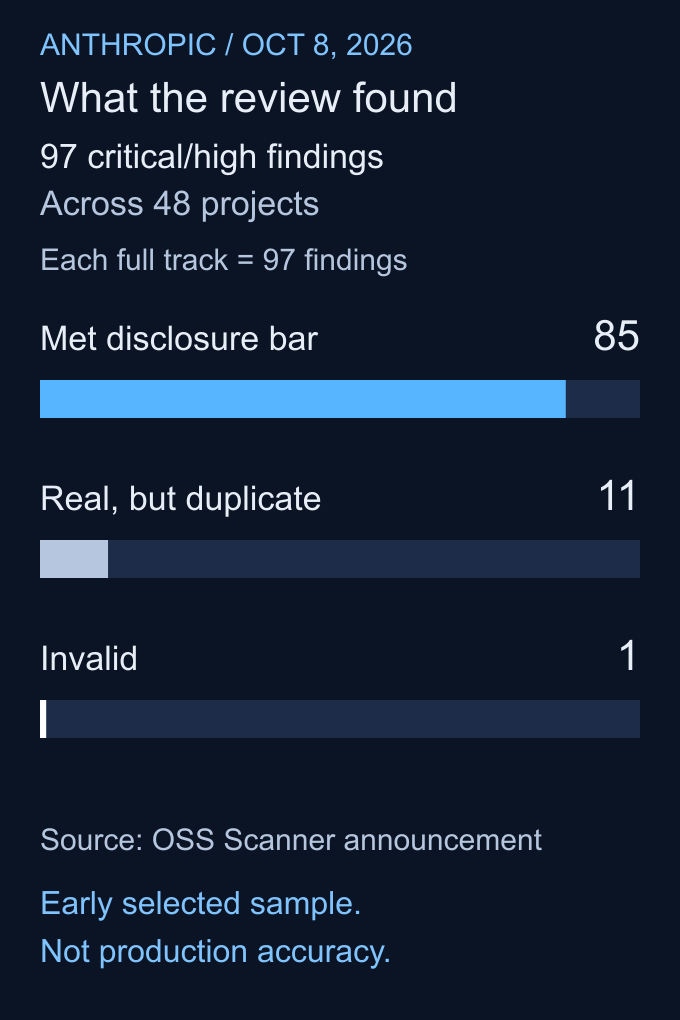
Figure 1. Anthropic's reported review of 97 selected critical- and high-severity findings across 48 projects. This is an early validation sample, not an independently reproduced production accuracy estimate.
The sample is encouraging within that scope. It does not establish accuracy across future reports or every severity level. Anthropic also says maintainers have reported inflated severity ratings and misunderstandings of their projects' threat models. A valid technical observation still needs an exposure assessment before it becomes an urgent security task.
For an agentic security team, the useful distinction is between finding a behavior and establishing its significance. Require the report to name the affected revision, reachable interface, necessary privileges and expected security boundary. Treat missing details as investigation work, rather than quietly supplying assumptions that make the finding sound worse.
Design the handoff around evidence
The following workflow is a proposal for an owned, isolated review environment. It has not been tested against OSS Scanner. Begin by preserving the original report and identifying the exact source revision. Give the finding a local identifier so later corrections, duplicate decisions and patch revisions remain attached to the same investigation.
Review the reproducer before running it. Permit execution only against an explicitly authorized local target with synthetic data and bounded resources. A report's request to fetch a dependency, contact a remote host or change the environment should not silently expand that scope. If reproduction needs more access, record the dependency and make a separate decision.
Once the behavior is reproduced, assess the security claim. Check whether the reported interface exists in the supported configuration and whether the stated attacker can reach it. Record a duplicate as a duplicate while retaining its connection to the original issue. If the report does not reproduce, preserve the failure and request the missing conditions instead of marking it valid because its explanation reads well.
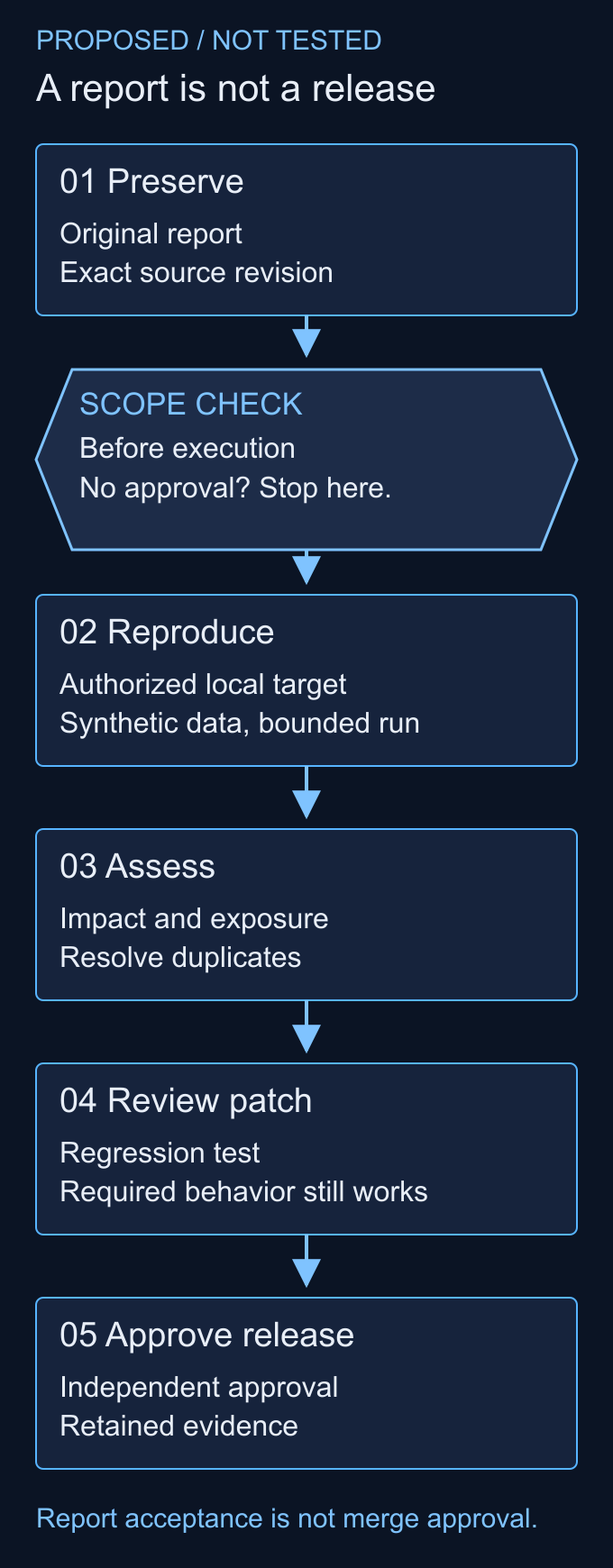
Figure 2. Proposed maintainer workflow. The execution boundary comes before reproduction; accepting a report does not authorize a patch merge or release. This is a design recommendation, not scanner telemetry.
Review the patch after the finding is understood. Ask for a regression test demonstrating the original failure, then run it against the candidate fix. Check the intended behavior too. In a proposed example involving an authorization check, a patch that blocks every request would stop the reported access but would not meet the application's requirements.
Keep merge and release approval separate from the agent that proposes the change. The reviewer should be able to inspect the original evidence, the reproduction result and the patch delta without relying on the agent's summary. That is the evidence package this workflow aims to produce.
Start with review capacity
A first trial should answer a narrow question: does this feed help this project ship verified fixes with an acceptable amount of maintainer work? Choose a bounded set of owned code and a review window the maintainers can support. Agree in advance on how to stop intake if the queue grows faster than the team can resolve it.
Track time spent reproducing findings, resolving duplicates, correcting severity and reviewing patches. Keep confirmed findings separate from accepted fixes and released fixes. Record reports that could not be assessed, too. Excluding them from the account would hide work the service created but the project could not finish.
This proposed trial would not measure the scanner's overall accuracy. It would measure whether the reporting workflow fits a particular project's capacity. No such trial was run for this article, and no savings or remediation speedup is claimed.
OSS Scanner's announcement offers a practical reason to revisit vulnerability intake. Anthropic is explicit that faster delivery removes a human review step before maintainers receive the report. Accept that trade only with a clear owner for the remaining work, and judge the service by the verified fixes the project can support.
Public-source analysis. No OSS Scanner enrollment, benchmark or vulnerability reproduction was performed. This is independent research and does not represent any employer or client.